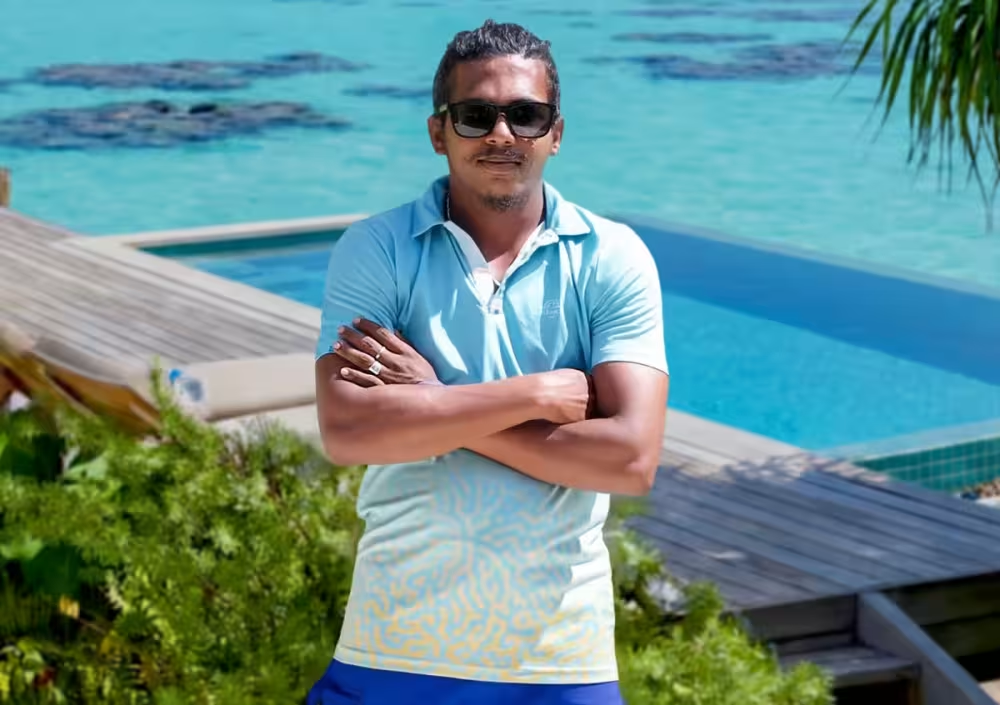
In the far south of the Maldives, on the small, unassuming island of GDH. Madaveli in Gaafu Dhaalu Atoll, the ocean is not just a view—it is everything. For Ahmed Ravee Haris, it was home, playground, and destiny. “I grew up in the water,” he says simply. “Since I was a kid, I was obsessed with anything related to the sea—fishing, free diving, surfing. My day was never fully complete without a dip in the sea.”
That childhood immersion in the turquoise lagoons of his home atoll shaped a life now dedicated to sharing the thrill of the ocean with visitors from around the world. Today, Ahmed is a multi-certified watersports instructor at Kandima Maldives, a lively, design-forward resort in Dhaalu Atoll celebrated for its vast lagoon and innovative aquatic offerings. His rise from a local island boy to one of the country’s most versatile watersports professionals mirrors the remarkable transformation of the Maldives’ watersports scene over the past decade.
Like many great stories, Ahmed began with a hurdle. In late 2016, a torn anterior cruciate ligament (ACL) sidelined him from the active lifestyle he loved. Forced to step away from most sports, he could have drifted away from the water. Instead, in 2017, he discovered a watersports training course organized by Villa Pvt at Sun Island resort. He enrolled immediately, completed the programme, and secured an internship at Robinson Club.
What started as a foothold became a launchpad. Hired first as boat crew, Ahmed’s drive and natural affinity for the sea saw him quickly promoted to boat captain and watersports attendant. Surrounded daily by guests and colleagues who often outperformed him in various disciplines, he found constant motivation. “I have met guests and colleagues who could outperform me in all watersports activities,” he reflects. “It kept driving me to improve.”
After four rewarding but formative years at Robinson Club, Ahmed felt ready for the next chapter. He joined Maldives Super Transfer Service (MSTS), a leading operator managing watersports across multiple resorts, and began pursuing advanced instructor certifications. His research led him to Bandos Maldives, long regarded as a premier training centre in the country. There, he earned his VDWS windsurfing instructor qualification first. Later, through an MSTS programme, he added BWSW certifications in wakeboarding and waterskiing. Most recently, after joining Kandima, he completed flyboard instructor training—theory in Malta, practicals back at Bandos.
Each new certification was not just a line on a resume; it was a deeper tool for connection. “Every certification I achieved allowed me to teach and explain to customers the safest and easiest ways to get them interested and excited,” Ahmed says. His approach goes beyond technique—he reads people. For anxious beginners convinced they will fail, he shifts their focus with light humour, a joke, or a request to pose for a photo. Suddenly, nerves ease. “It’s not as difficult as it seems,” he tells them, and more often than not, they believe him—and succeed.
That moment of breakthrough is what fuels him most. “I love doing my job because it’s always been my passion,” he says. “When you know that because of you, someone around the world has decided to get into the sports and make that their passion and achieve new heights themselves one day—that feeling is everything.”
One encounter remains etched in his memory. A 13-year-old boy, visiting the Maldives for the first time, arrived wide-eyed and eager. He fixated on wakeboarding and revealed astonishing natural talent. Starting from zero, in just three sessions he was attempting—and landing—backflips, succeeding twice out of five tries. “Honestly, that was by far the fastest learner I’ve seen in my career,” Ahmed recalls, the pride still evident in his voice.
The role is not without its tests. Coordinating multiple guests with varying skill levels, expectations, and schedules—often constrained by weather, equipment availability, or staffing—can be the most demanding part of the day. Yet Ahmed thrives on solutions. “Most of the time, I try to offer alternative solutions to keep the customers happy,” he says, a quiet testament to the service culture that defines Maldivian hospitality.
Looking back, Ahmed marvels at how quickly the industry has evolved. “In the past few years, watersports has changed a lot,” he observes. Veteran managers still share stories of an era when resorts offered only kayaks, windsurfers, and catamarans—no engines, no foils, and salaries of just a few hundred dollars. Today, the landscape is unrecognisable: wing foils silently glide above the waves, electric e-foils hum across lagoons, flyboards launch riders into the air on jets of water, and even jetcars skim the surface like aquatic go-karts.
For young Maldivians growing up in islands much like his own—or for any outsider dreaming of a life in watersports—Ahmed offers guidance forged from experience: “Never stop learning and improving your skills. There are always new things you can achieve and many people to surpass. Compete with your limits to go forward, achieve your dreams. Learn and teach, and shape the ones after you for the future.”
In a nation where the sea defines identity, economy, and joy, Ahmed Ravee Haris is more than an instructor. He is a bridge—between local island roots and global visitors, between tradition and innovation, between fear and exhilaration. And every day, in the sparkling lagoons of Kandima, he passes on the same obsession that has defined his life: the unbreakable pull of the ocean.